
A partial roll can have its remaining length marked on it and still be difficult to work into the next job. The question is not only whether there is enough film left. The roll also has to fit the windows well enough to make using it worthwhile.
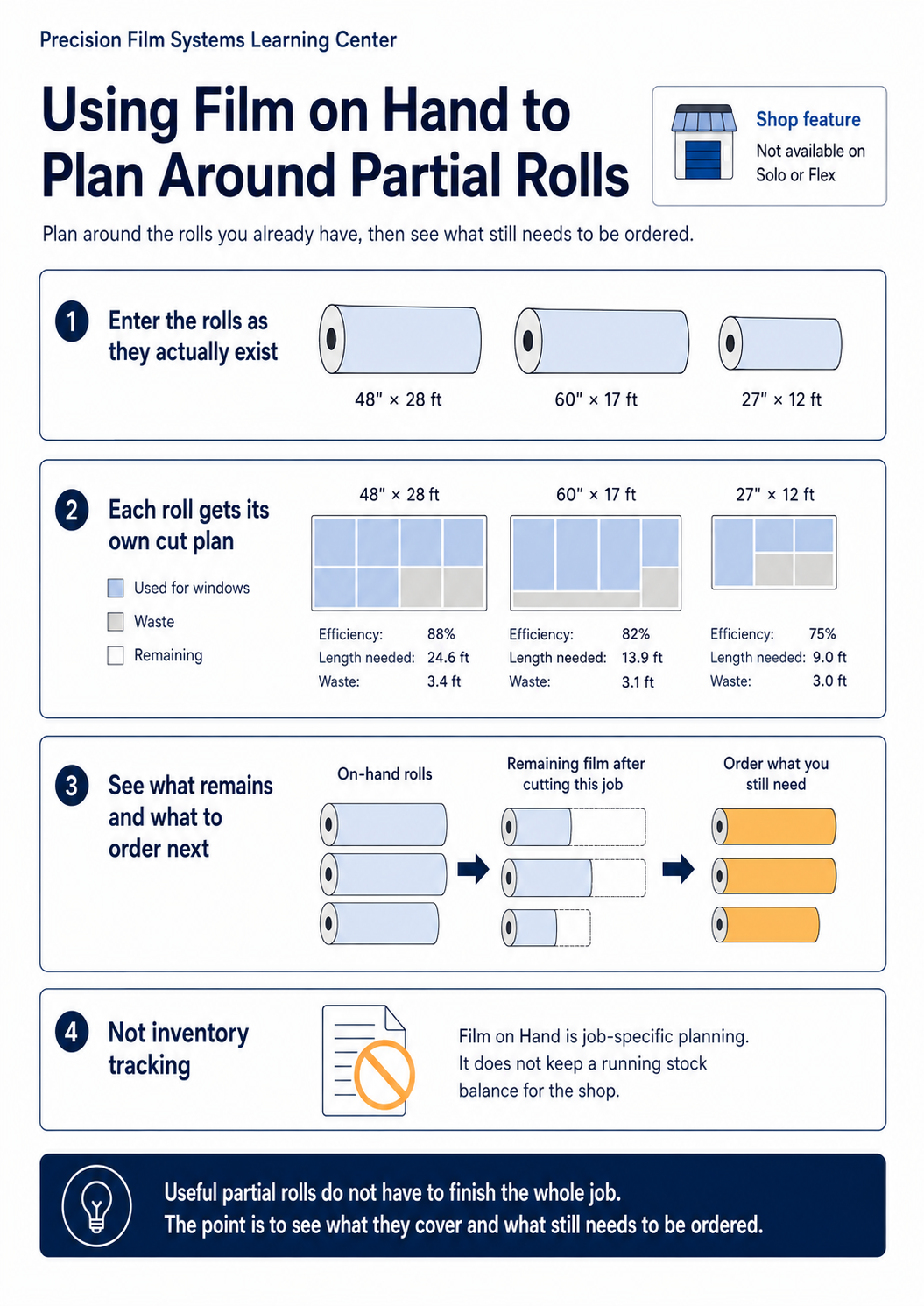
Film on Hand in Precision Film Systems lets you enter the actual width and usable length of the rolls you have available, then build the cut plan around that material before deciding what still needs to be ordered. Film on Hand is included with the Shop plan and is not available on Solo or Flex.
The old process usually meant planning the job more than once
When planning manually, the first step would normally be figuring out which roll width made the most sense for the job and how the windows should be laid out.
After that came the partial rolls.
You might find that you already had some of the width you planned to order, then start working through the windows again to see how far that roll would get you. Another partial roll in a different width might also be worth checking. Once enough existing material was involved, the original order could change.
The frustrating part was the back-and-forth. The job had already been planned once, but every usable partial roll created another material question.
Film on Hand is built around that part of the process.
Start with the roll width you would normally choose
Film on Hand works best when there is already a baseline for the job.
Start by looking at the standard roll options and deciding which width makes sense if the job were being ordered from new material. That gives you something useful to compare the partial rolls against.
If a 60-inch roll lays the job out very well, but the partial rolls sitting in the shop would drop the efficiency by 10 or 15 percent, using them may not be worth it. They may fit another job better later.
The goal is not to empty the roll rack. The goal is to see whether the material already on hand fits this job well enough to use.
Enter the rolls as they actually exist
Film on Hand uses custom roll dimensions.
Each roll is entered with its actual usable width and the amount of usable film remaining. The rolls can have different widths and different lengths.
A shop might have a 48-inch partial with 28 feet left, a 60-inch roll with 17 feet remaining, and a 27-inch-wide piece left from another job. Those can be entered as separate rolls and planned together.
This is one of the main reasons Film on Hand exists. Partial rolls rarely sit on the rack in neat, matching quantities. The plan needs to work with the material that is physically there.
The partial rolls can change what you order
The roll width that looked best before checking existing material is not always the width that makes the most sense afterward.
Suppose the original plan points toward ordering a 60-inch roll. After entering several partial rolls, enough of the job may be covered that the remaining windows lay out better on a 48-inch or 72-inch roll.
At that point, the original material decision has changed.
Instead of asking which width works best for the entire job, the question becomes which width works best for what is still left after the usable partial rolls are taken into account.
That can reduce the amount of new material that needs to be purchased without forcing the job onto rolls that do not fit it well.
The remaining-job metrics help with the next order
Once the Film on Hand rolls are worked into the plan, Precision Film Systems also shows the material requirements for the windows that remain.
That makes it much quicker to look at the unfinished part of the job and decide what should be ordered next.
The remaining windows may point back to the original roll width, or they may make another width more attractive now that part of the job has already been covered.
This is where Film on Hand becomes more useful than simply seeing how many windows can be cut from a partial roll. It helps connect the material already in the shop with the material that still needs to be purchased.
A partial roll does not have to be used
Having enough film to cut some of the windows does not automatically make a partial roll a good choice.
The layout still matters.
If the standard roll plan is highly efficient and an on-hand roll uses considerably more film for the same windows, it may make more sense to leave that partial alone. There is nothing wrong with saving a usable roll for a job that fits it better.
Film on Hand gives you another material option to evaluate. The decision to use it still comes down to how that material fits the job.
Film on Hand does not maintain shop inventory
Film on Hand does not track every roll in the shop or keep a running inventory balance.
The shop still needs to know what material is available and how much usable film remains. The rolls being considered for the job are entered into Film on Hand when the cut plan is being built.
That applies whether the material is almost a full roll or a short partial left from another installation.
The feature is meant to answer a specific planning question: given the rolls available right now, how much of this job can they cover, and what material will still be needed afterward?
Where Film on Hand fits
Film on Hand is most useful after the normal roll-width comparison has already given you a good starting point.
From there, the partial rolls in the shop can be tested against the same job without manually rebuilding the layout for each one. You can see whether they are worth using, how much of the job they cover, and whether using them changes what should be ordered for the remaining windows.
Sometimes the original order stays exactly the same.
Sometimes the partial rolls cover enough of the job that a different width makes more sense for what is left.
That is the decision Film on Hand was built to make easier.
Frequently asked questions
Is Film on Hand an inventory system?
No. Precision Film Systems does not maintain a running list of the rolls in the shop through Film on Hand. You enter the specific rolls you want to consider while planning a job.
Can Film on Hand use rolls with different widths?
Yes. Each roll can have its own width and remaining usable length. That could include a standard-width partial or something like a 27-inch-wide piece left from another job.
Is Film on Hand only for full rolls kept in stock?
No. Partial rolls are one of the main reasons to use it. A roll only needs a known usable width and remaining length to be considered in the plan.
What happens if the rolls on hand do not finish the job?
Precision Film Systems shows what remains after the available rolls are used so the rest of the material can be planned and ordered.
Which Precision Film Systems plans include Film on Hand?
Film on Hand is a Shop feature. It is not included with Solo or Flex.