
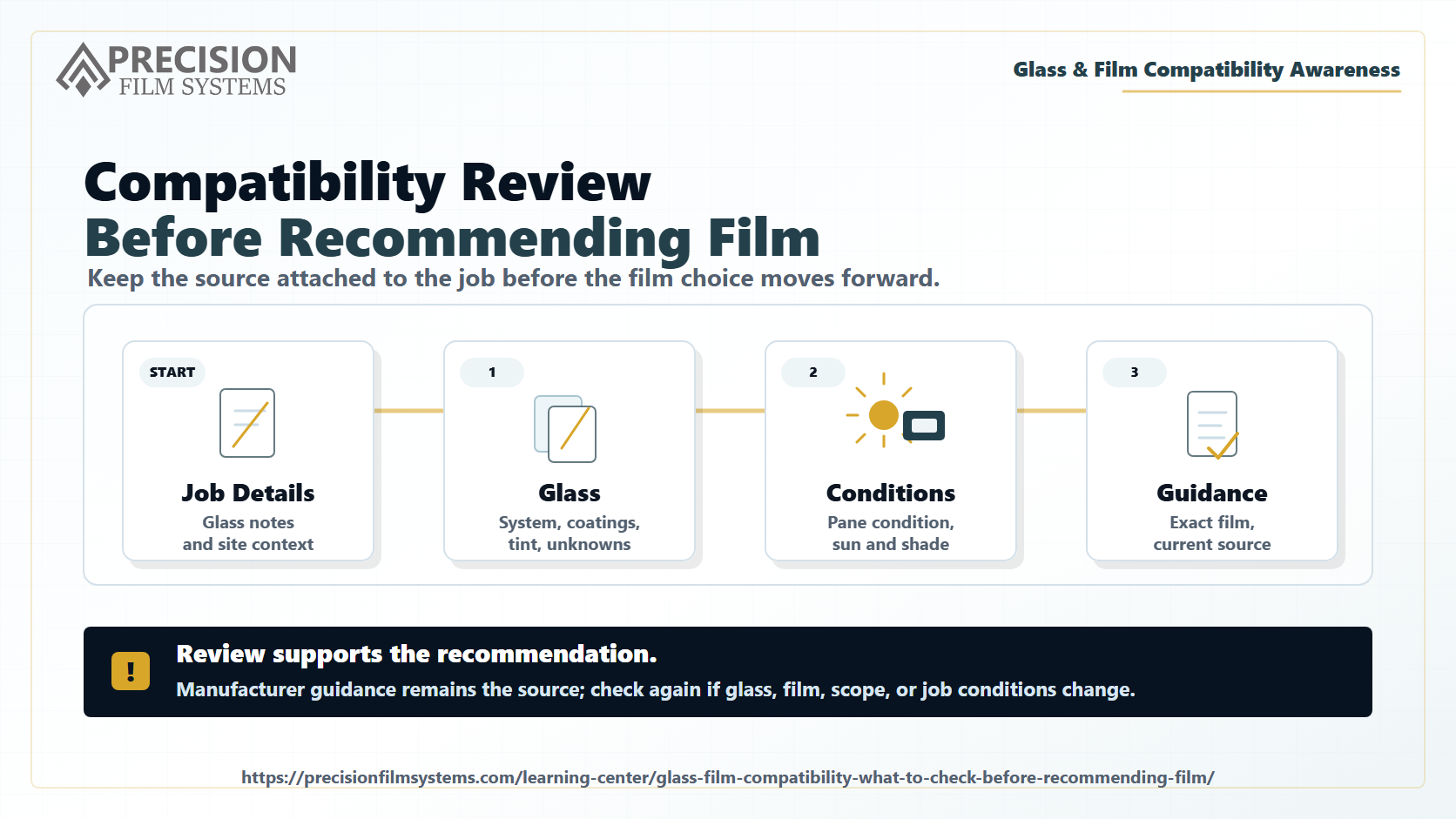
Compatibility review is the pause between "this film looks right" and "this film is ready to recommend for this glass."
That pause matters. A film can meet the customer's goals for glare, heat, appearance, or privacy and still need a closer look at the glass and job conditions. The review is not about making the job sound risky. It is about keeping the recommendation tied to the details that affect whether a specific film belongs on a specific pane.
This article is an awareness checklist. It does not replace current manufacturer guidance, project-specific technical review, or the requirements of the film or glass manufacturer. It gives estimators, installers, and shop teams a practical way to collect better information before the final recommendation is made.
In Practical Terms
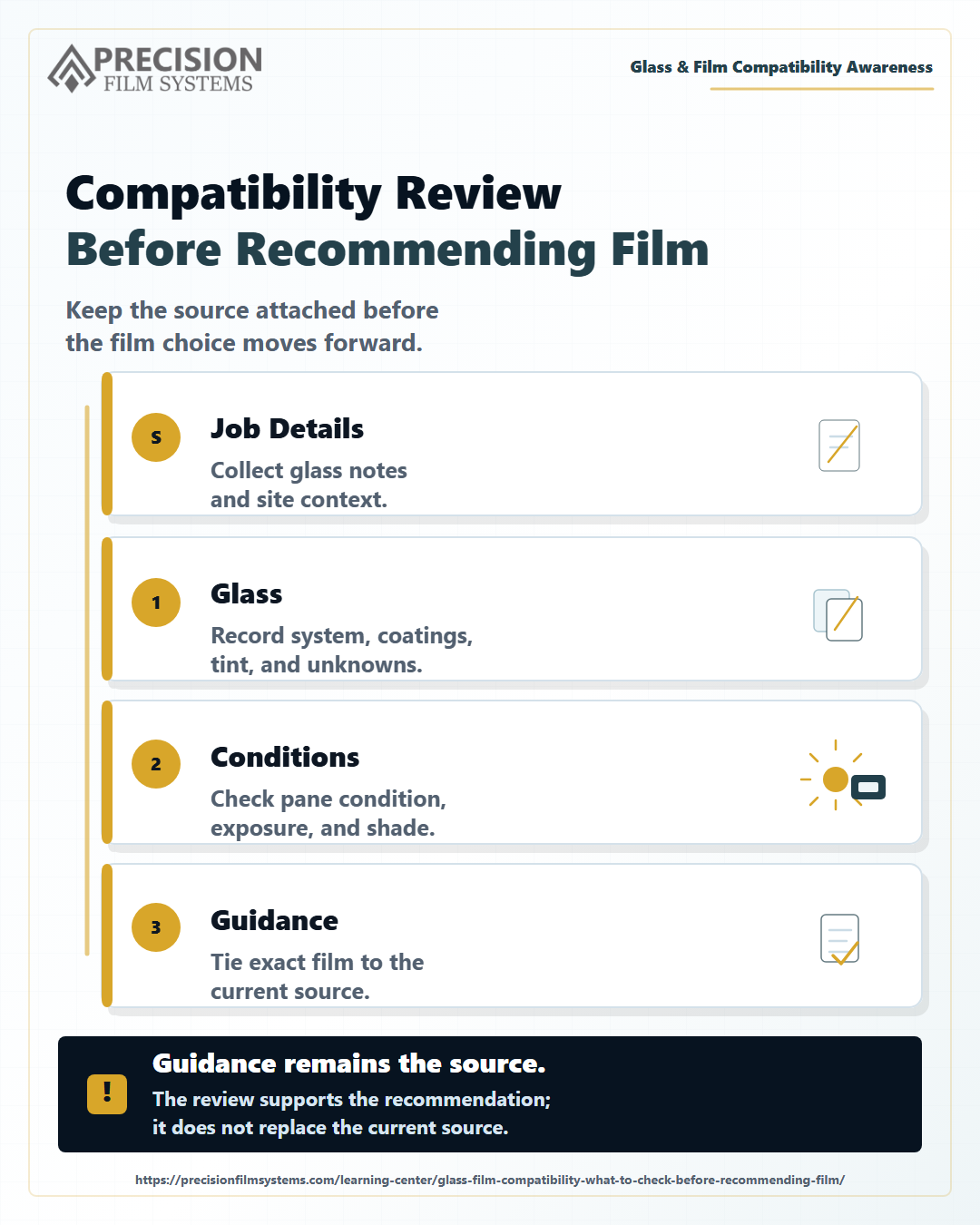
Before recommending flat glass window film, identify the glass system as clearly as the job allows, inspect the pane and frame, document exposure and partial shading, record the exact film being considered, and check the current manufacturer source. If something is unknown, mark it as unknown instead of filling the gap with a guess.
| Compatibility factor | What to capture before the recommendation |
|---|---|
| Glass system | Single-pane or insulated glass unit, glass type when known, coatings, tint, and specialty conditions |
| Visible condition | Cracks, chips, seal failure, edge damage, frame concerns, scratches, and prior repairs |
| Exposure pattern | Direction, direct sun, partial shade, overhangs, blinds, curtains, and nearby reflective surfaces |
| Exact film | Manufacturer, series, product code, shade, construction, absorption, and application side |
| Current source | Film-to-glass chart, technical bulletin, dealer portal result, written response, or case reference |
| Job file | Review date, unknowns, conditions, exceptions, and notes that should follow the handoff |
Compatibility Starts With the Complete Glazing System
Film is installed on a pane, but the pane is part of a larger glazing system. The recommendation may depend on whether the glass is single-pane, part of an insulated glass unit, laminated, tinted, tempered, heat-strengthened, annealed, coated, or already carrying film.
It may also depend on the application side, the size of the pane, the frame condition, the edge seal, the exposure, and whether the customer uses blinds, shades, or displays close to the glass. A compatibility review should connect those details before the film choice becomes a quote, order, or installer handoff.
1. Identify What the Glass Is
Start with the glass construction. Is it single-pane glass, an insulated glass unit, laminated glass, tinted glass, tempered glass, heat-strengthened glass, annealed glass, or a specialty product? Some jobs give you clear labels, schedules, or building documents. Others give you only field observations and a few clues.
When the glass type can be confirmed, record the source. That source might be a stamp, spacer marking, building schedule, manufacturer label, customer-provided document, or written confirmation from another project stakeholder. When the glass type cannot be confirmed, record it as unknown.
The unknown label is useful. It tells the next person that the review still has an open item. It is much better than assigning a glass type because it feels likely.
2. Record Coatings, Tint, and Existing Film
Low-E coatings, factory tint, reflective glass, laminated interlayers, and existing film can change the conversation. A clear pane and a tinted pane may not be treated the same way in a manufacturer chart. An insulated glass unit with a Low-E coating may need different notes than an uncoated single pane.
The practical job-file question is simple: what did you see, and how did you know? Record labels, markings, reflection-test observations, detector results, customer records, and any limits in what could be confirmed. If existing film is present, note whether it will be removed, whether its product is known, and whether the pane has any visible damage after removal.
Do not turn a Low-E suspicion into a completed answer. The surface location and glass construction may matter, and some jobs need a manufacturer or technical-service response before the recommendation is treated as ready.
3. Inspect Visible Pane and Frame Condition
Compatibility review is not only about the spec sheet. The physical condition of the glass and frame should be documented before a film recommendation moves forward.
Look for conditions such as:
- cracks, chips, scratches, or edge damage
- fogging, failed seals, or moisture inside insulated glass units
- old glazing compound, loose stops, stressed gaskets, or frame movement
- prior film, adhesive residue, or removal damage
- unusual glass size, shape, slope, or framing condition
- customer concerns about previous breakage, leaks, or failed panes
These notes do not diagnose every cause or predict every outcome. They keep visible conditions attached to the job so the recommendation is not made from performance numbers alone.
4. Document Exposure and Partial Shading
Exposure affects how the glass is used in the real world. A north-facing pane under a deep overhang may have a different field condition than a west-facing elevation with strong afternoon sun. Partial shading can also matter because one part of a pane may heat differently than another.
Record conditions that would be hard to recreate from a pane list later:
- elevation or direction when known
- direct sun periods that are obvious during the site visit
- overhangs, mullions, exterior fins, trees, signs, or neighboring buildings
- interior blinds, shades, curtains, displays, racks, or dark objects near glass
- nearby reflective surfaces that may increase exposure on certain panes
- mixed exposure conditions across the same job
A photo can help here. The goal is not to create a perfect heat model. The goal is to make the exposure pattern visible enough that the shop can check the film choice against the actual job, not an idealized version of it.
5. Review the Exact Film Being Considered
"A ceramic film" or "a darker shade" is not specific enough for compatibility review. The review should be tied to the exact manufacturer, product family, product code, shade, and application side being considered.
This matters because products that seem similar in conversation can differ in solar absorption, visible reflectance, construction, exterior-use rating, available widths, and written manufacturer guidance. A substitution made for roll-width availability, lead time, color match, or price may require the compatibility review to be checked again.
The material plan and compatibility review should stay connected, but they are not the same thing. A cut layout can show how much film the job may use. It does not decide whether that film is the right product for the glass.
6. Check the Current Manufacturer Source
Once the glass notes, job conditions, and exact film are known, check the current manufacturer source. Depending on the brand and product line, that may be a film-to-glass chart, technical bulletin, warranty guide, dealer portal result, technical-service email, or project-specific case reference.
Keep the source with the job file. Include the date reviewed and any assumptions or conditions stated in the source. If the answer depends on glass thickness, coating location, application side, exposure, pane size, edge condition, or written response, those conditions should travel with the job.
Do not reduce a conditional answer to a one-word note. "Checked" is not the same as showing what was checked, which film was checked, which glass condition was used, and whether open questions remain.
Keep the Review With the Job
Compatibility review can get lost when a job moves from sales to office to ordering to installation. The estimator may remember why a film was selected, but the person cutting material or installing on site may only see a product name.
The job file should keep the review visible enough that a change can be caught. Recheck when the selected film changes, the glass group changes, the application side changes, a replacement pane is discovered, the job expands to a different elevation, or the manufacturer source used during the quote is no longer current.
A short handoff note can be enough when the source is attached elsewhere. The note should still tell the team where the source is, what film it applies to, what glass group it applies to, and whether any unknowns remain.
How Precision Film Systems Fits Into This
Precision Film Systems is not a compatibility decision tool. The manufacturer remains the source for product-specific film-to-glass guidance.
Precision Film Systems helps on the job-information side. Measurements, film selections, roll-width planning, notes, and handoff details can stay together so the shop does not separate the material plan from the compatibility status. If the film choice still needs review, that status should remain visible while the quote and cut plan are being built.
That is the practical benefit: fewer silent assumptions. The team can see what is ready, what changed, and what still needs to be checked before the recommendation moves forward.
Practical Takeaway
Before recommending film, slow the job down long enough to document the glass system, coatings, visible condition, exposure, partial shading, exact film, and current manufacturer source.
A compatibility review is strongest when it stays attached to the job file. That way, if the glass, film, scope, or job conditions change, the team can see whether the recommendation needs another look before material is ordered or installed.
Glass and film compatibility checks
Can this article tell me which film is compatible with a specific glass type?
No. This article explains what information to collect before a recommendation is finalized. Product-specific compatibility should be checked against the current manufacturer source for the exact film, glass condition, and job conditions.
What should I do if the glass type is unknown?
Record the glass type as unknown, document what is visible, and gather more information before treating the recommendation as final. Unknown glass should not be forced into a confident category just to finish a quote.
Does Low-E glass always mean film cannot be used?
No blanket rule should be used. Low-E compatibility depends on the glass system, coating location when known, film construction, exposure, shading, application side, and current manufacturer guidance.
Why does partial shading matter in a compatibility review?
Partial shading can create uneven heating across a pane. It is one of several job conditions that should be documented before the film choice is finalized.
Should compatibility notes stay with the installer handoff?
Yes. The handoff should keep the selected film, glass notes, source checked, date reviewed, and any open questions connected to the job so a later product or scope change can be caught.